Loading... Today

-- 0

-- 0

India’s Power Transition Shifts Focus from Renewable Capacity to Grid Reliability and Energy Security
The Electrical Post
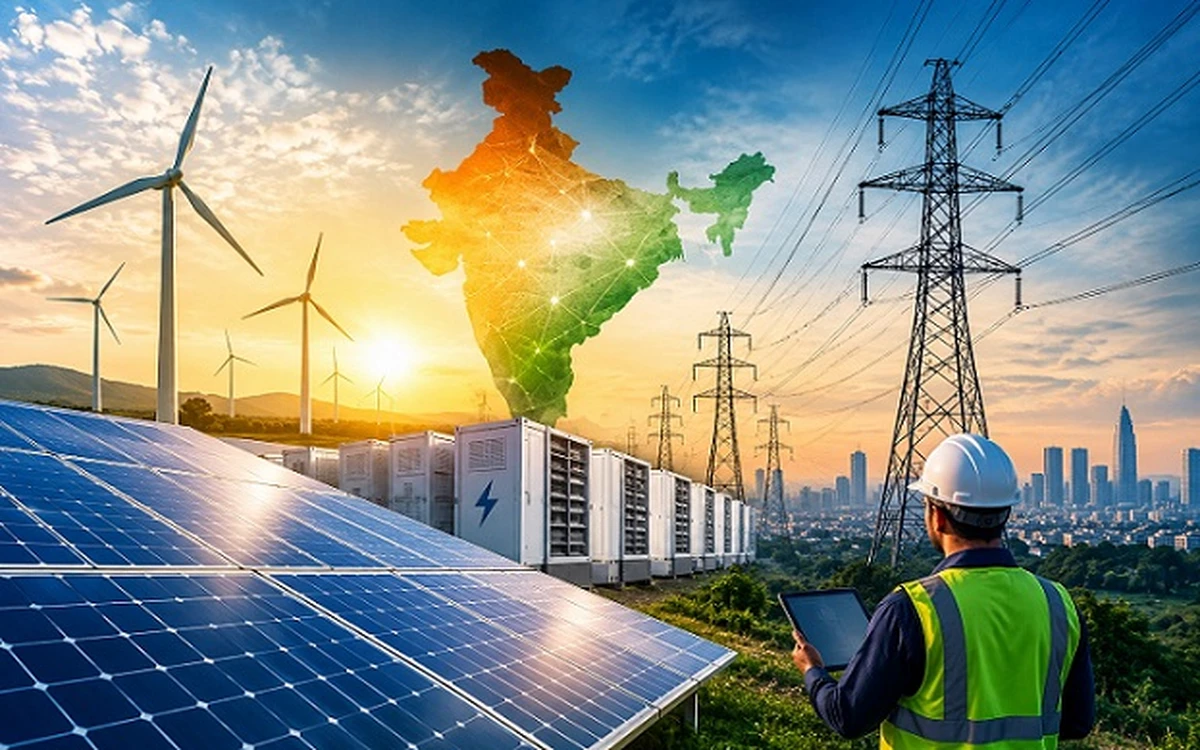
India’s next phase of power-sector growth will depend on strengthening transmission infrastructure, expanding energy storage, improving grid flexibility and building domestic clean-technology manufacturing capabilities, as electricity demand accelerates through 2035.
India’s energy transition is entering a new phase, moving beyond renewable capacity additions towards building a resilient power system capable of delivering clean, reliable and affordable electricity. Rising demand from industrialization, urbanization, electric mobility, cooling systems, data centers and green hydrogen production is expected to increase electricity’s share in the country’s total energy consumption.
Electricity demand is projected to grow at 5.56% annually between 2025 and 2035, compared with overall energy demand growth of 2.47%. Electricity’s share of the total energy basket could rise to nearly 25% by 2035, from approximately 19% in 2025.
Data centers and green hydrogen production are expected to become increasingly significant sources of demand, with their combined electricity consumption potentially increasing nearly ninefold to around 240 terawatt-hours by 2035. At the same time, distributed generation is expected to account for a growing share of electricity consumption, potentially rising from approximately 13% in 2025 to 16% by 2035.
Meeting these changing requirements will demand a diversified generation mix, stronger transmission and distribution networks, energy storage and more flexible electricity markets.
Renewable Energy to Drive Capacity Expansion
India achieved its 2030 Nationally Determined Contribution target of obtaining 50% of cumulative installed power capacity from non-fossil sources ahead of schedule. The target for 2035 is 60%.
Renewable energy is expected to meet most of the incremental electricity demand through 2035, with utility-scale solar remaining the principal driver of capacity additions, supported by wind, hydropower and storage-backed renewable projects.
S&P Global forecasts that India will add approximately 300 gigawatts of solar photovoltaic capacity between 2026 and 2035, alongside around 95 GW of energy storage capacity.
Coal will continue to play a significant role in electricity generation, although its share is expected to decline from approximately 70% in 2025 towards 60%, according to S&P Global forecasts. Its role is also expected to evolve, with coal-based generation increasingly required to provide flexibility during evening demand peaks and periods of lower renewable generation.
Small modular reactors and coal-based generation supported by carbon capture and storage are also expected to gain strategic importance, although their contribution to the generation mix is likely to remain limited over the next five to ten years.
Commercial and industrial consumers are expected to play a larger role in renewable energy procurement. According to S&P Global estimates, their share of renewable capacity additions could rise from nearly 19% in 2025 to approximately 30% by 2035.
However, the growing availability of renewable capacity will need to be matched by improvements in grid infrastructure, system flexibility and the ability to integrate intermittent generation reliably.
Transmission Infrastructure Emerges as a Critical Challenge
India’s transmission network will be central to accommodating the next wave of renewable energy development. Although the country has established a substantial national transmission backbone, delays in infrastructure execution are emerging as a concern.
Total transformation capacity stood at approximately 1,486 gigavolt-amperes as of July 2026. However, substation capacity additions have slowed. During fiscal year 2024–25, around 77% of targeted additions were achieved, compared with earlier achievement rates exceeding 90%. Although performance improved in fiscal year 2025–26, infrastructure additions remain below the pace required for the next phase of renewable integration.
The challenge is particularly significant because renewable projects can be developed faster than the transmission corridors needed to evacuate their electricity. As solar and wind capacity expands in Rajasthan, Gujarat, Karnataka and Andhra Pradesh, transmission infrastructure must be available before projects are commissioned.
Delays can lead to grid congestion, commissioning setbacks, stranded generation capacity and increased curtailment risks. According to the Ministry of New and Renewable Energy, more than 6 terawatt-hours of solar generation went undelivered to the grid between April and June 2026 because of delays in transmission development.
Addressing these challenges will require better coordination between interstate transmission corridors, intrastate networks and last-mile evacuation infrastructure, ensuring that grid development keeps pace with the increasingly dispersed and market-driven expansion of renewable energy.
Renewable Curtailment Highlights the Need for Grid Flexibility
The rapid growth of solar photovoltaic capacity is increasing pressure on India’s power system to balance electricity supply and demand. As renewable penetration rises, insufficient storage, flexible demand and dispatchable generation can make it difficult to accommodate high levels of solar output during daylight hours.
India’s grid experienced renewable energy curtailment of approximately 2,800 gigawatt-hours during 2025 and 3,300 GWh during the first six months of 2026, with solar accounting for more than 85% of the curtailed electricity.
According to an S&P Global Energy assessment, transmission bottlenecks accounted for approximately 10% of curtailment, while the remaining 90% was attributed to grid-security concerns associated with system inflexibility.
The contrast between different operating days in April 2026 illustrates the scale of the challenge. Peak solar photovoltaic curtailment reached 22 GW on April 5, compared with 1 GW on April 17.
These figures underline the need to develop energy storage, improve flexible generation capabilities and encourage demand that can respond to changing renewable output. The effectiveness of India’s energy transition will increasingly depend not only on installed capacity but also on how efficiently electricity can be delivered, balanced and consumed.
Domestic Manufacturing Becomes Central to Energy Security
As renewable energy assumes a larger role in electricity generation, India’s energy security will increasingly depend on domestic manufacturing capabilities and reliable access to critical components and minerals.
Solar modules, cells, wafers, batteries, inverters, power electronics and critical minerals are becoming strategically important to the power sector. Measures such as basic customs duties, the Approved List of Models and Manufacturers (ALMM) requirements and production-linked incentive schemes are intended to strengthen domestic supply chains and reduce dependence on imports.
However, vulnerabilities remain in upstream solar manufacturing. Although domestic module capacity has expanded, cells, wafers, ingots and polysilicon remain important areas of concern. The implementation of ALMM List-II for solar cells from June 2026 has highlighted the potential mismatch between policy requirements and the availability of certified domestic supplies.
While cell manufacturing capacity is expected to improve, wafers and other upstream materials could become bottlenecks if localization requirements advance faster than domestic manufacturing capabilities.
Battery storage presents a similar challenge. India’s battery ecosystem remains concentrated in downstream activities, including pack assembly, battery management systems and project integration, while commercial-scale cell manufacturing and upstream active-material production are at an earlier stage.
The Advanced Chemistry Cell production-linked incentive scheme provides a foundation for expanding domestic manufacturing, targeting 50 GWh of advanced chemistry cell capacity. Some early estimates suggest that India’s cell manufacturing capacity could reach 140 GWh by 2030, although this will depend on execution.
The mobility sector is expected to support battery manufacturing growth because of its stronger demand, cost economics and policy support. This expansion could also improve the cost and supply foundation for stationary energy storage, which will become increasingly important for integrating renewable electricity into the grid.
Clean Technology Investment Could Reach $50 Billion by 2035
India’s next energy security challenge will extend beyond fuel imports to the infrastructure, manufacturing supply chains and electricity markets required to operate a renewable-heavy power system.
Solar and wind capacity are expected to continue expanding, but transmission development, storage deployment, grid flexibility and domestic manufacturing will determine how effectively this capacity supports economic growth.
A conservative estimate suggests that localizing India’s clean-technology supply chain could require investments of between $40 billion and $50 billion by 2035. Achieving this will require a phased approach that prioritizes the domestic production of critical components while establishing clear strategies for securing and diversifying imports of materials and technologies that cannot yet be sourced domestically.
India’s power-sector transition is therefore moving beyond the pursuit of renewable capacity targets. The next stage will focus on ensuring that clean electricity can be generated, transmitted, stored and delivered reliably and affordably, while reducing exposure to external supply-chain risks.
This is a thought leadership report issued by the S&P Global Institute. This report does not constitute a rating action, neither was it discussed by a rating committee.
15 hours ago
Total Views : 15

2 days ago
Total Views : 46
2 days ago
Total Views : 51
2 days ago
Total Views : 39
5 days ago
Total Views : 30

5 days ago
Total Views : 34

5 days ago
Total Views : 48

last week
Total Views : 187

last week
Total Views : 34
last week
Total Views : 69